Rounding Calculator – A Complete Guide to Simplifying Numbers Without Mistakes
Numbers are everywhere.
From the moment you wake up and check the time to the moment you go to sleep after managing your expenses, numbers quietly shape your day. Yet, not all numbers are easy to understand. Some are long, messy, and unnecessarily precise.
That’s where rounding becomes useful.
Instead of dealing with complex figures, we simplify them. We make them easier to read, easier to compare, and easier to use in real situations. But even though rounding looks simple at first, it can quickly become confusing when decimals, large values, or specific rules are involved.
This is exactly why tools like a rounding calculator exist—to remove confusion and give clear, instant results without requiring deep thinking or memorization of rules.
What Does Rounding Really Mean?
At its core, rounding is about approximation.
You take a number and adjust it to the nearest simpler value. This could mean:
Turning decimals into whole numbers
Simplifying large figures
Adjusting values to match a certain level of accuracy
For example:
4.6 becomes 5
12.3 becomes 12
98 becomes 100 (when rounding to the nearest hundred)
The goal is not to change the meaning of the number, but to make it more practical.
Why Rounding Is Used in Everyday Life
Rounding is not just a math concept—it’s a daily habit.
Think about how often you:
Estimate the total price while shopping
Round time (e.g., “about 10 minutes”)
Simplify distances or measurements
Adjust numbers when planning a budget
In real life, exact precision is often unnecessary. What matters is clarity.
Rounding helps us make quick decisions without getting lost in details.
The Basic Rule (Simple but Powerful)
Even though rounding can get complex, the basic rule stays the same:
If the next digit is 5 or more → round up
If it’s less than 5 → round down
This rule works in most situations, whether you are dealing with small numbers or large ones.
Understanding Decimal Rounding
Decimals are where most people start to feel unsure.
Let’s take a few examples:
3.67 → becomes 3.7 (rounded to one decimal place)
8.49 → becomes 8.5
12.105 → depends on how many decimal places you want
The challenge is not the rule—it’s applying it correctly every time.
This is where using a rounding calculator makes things easier. Instead of checking digits manually, the result is calculated instantly and accurately.
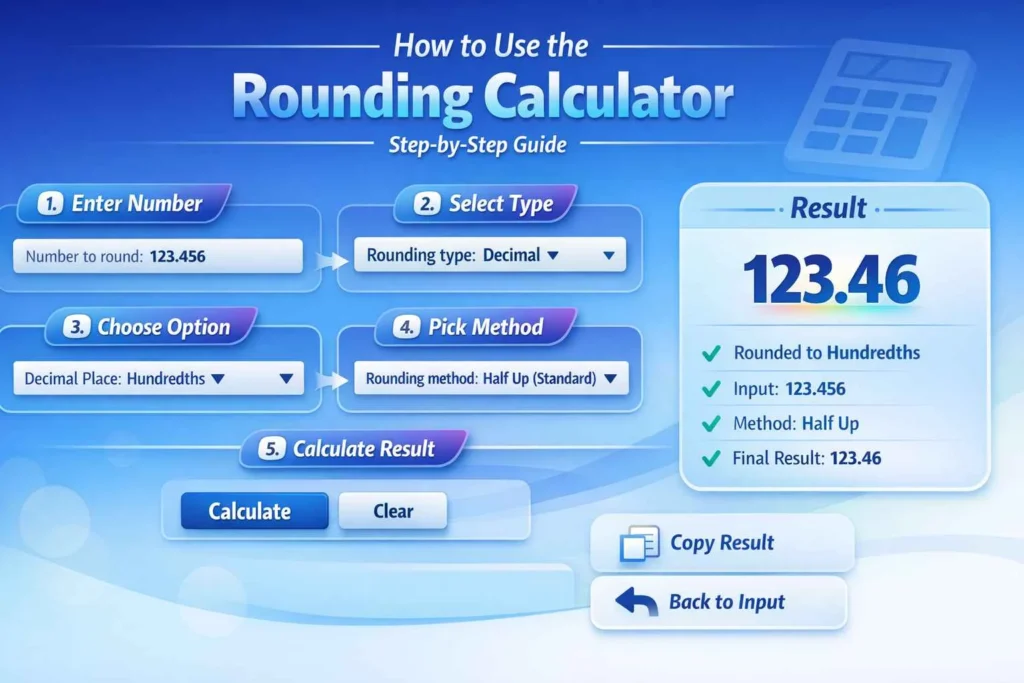
How to Use the Advanced Rounding Calculator
Using this tool is straightforward. Follow these steps:
1. Enter Your Number
Type the number you want to round in the “Number to round” field.
Examples:
123.456,0.789, or1.2e-5
2. Choose Rounding Type
Select how you want to round:
Decimal → round to decimal places (e.g., 2 decimal places)
Whole number → round to tens, hundreds, etc.
Fraction → round to nearest fraction (like 1/2 or 1/4)
3. Select the Precision Option
Depending on your choice:
Decimal → choose tenths, hundredths, etc.
Whole → choose ones, tens, hundreds
Fraction → choose 1/2, 1/4, 1/8, etc.
4. Pick a Rounding Method
Choose how rounding should behave:
Half up → standard rounding (most common)
Half down → rounds .5 downward
Half even → banker’s rounding
Ceiling → always rounds up
Floor → always rounds down
Truncate → cuts off extra digits
5. Click “Calculate”
The tool will:
Show the rounded result
Display step-by-step explanation
Explain method and factor used
6. Copy or Go Back
Click “Copy Result” to copy the answer
Click “Back” to try another calculation
7. Reset (Optional)
Use the “Clear” button to reset all fields.
Example
If you enter 123.456, choose:
Decimal → Hundredths
Method → Half up
Result: 123.46
Rounding to Whole Numbers
Sometimes, decimals are not needed at all.
In those cases, rounding to the nearest whole number is the best option.
Examples:
6.7 → 7
2.4 → 2
9.5 → 10
This is one of the most common forms of rounding because it simplifies numbers completely.
Rounding Large Numbers
As numbers grow, rounding becomes more important.
Imagine working with:
1,487
23,762
982,134
Instead of using exact values, you might round them to:
nearest 10
nearest 100
nearest 1000
This makes data easier to read and compare.
Rounding in Financial Situations
Money is one of the most common areas where rounding is used.
For example:
Prices are often rounded for simplicity
Budgets use approximate values
Taxes and calculations involve rounded figures
Even small rounding differences can matter in finance, which is why accuracy is important.
Rounding in Education
Students learn rounding early in school, but the difficulty increases over time.
At first, it’s simple:
round to nearest whole number
Later, it becomes:
round to decimal places
round to significant figures
apply rounding in word problems
Tools help students understand results faster and reduce mistakes.
Rounding in Science and Engineering
In scientific fields, rounding is not just about simplicity—it’s about precision.
Numbers are often rounded to match measurement limits.
For example:
experimental data
lab results
engineering calculations
Too much precision can be misleading, so controlled rounding is necessary.
Different Types of Rounding
Rounding is not just one method. There are several types:
Rounding to Nearest Value
The most common method.Rounding Up
Always increase the value.Rounding Down
Always decrease the value.Rounding to Decimal Places
Control how many digits remain after the decimal.Rounding to Significant Figures
Used in science and precise calculations.
Why Manual Rounding Causes Errors
Even though the rules are simple, mistakes happen.
Common issues include:
misreading digits
rounding the wrong place
forgetting rules
working too quickly
These small mistakes can lead to incorrect results.
Using a rounding calculator removes this risk entirely.
How Online Tools Make It Easier
Modern tools simplify the process completely.
Instead of thinking about rules, you just:
enter the number
choose how to round
get the result instantly
This saves time and reduces mental effort.
Step-by-Step Example
Let’s take a number:
👉 47.836
You can round it in different ways:
nearest whole → 48
one decimal → 47.8
two decimals → 47.84
The result depends on your goal.
Practical Benefits
Using rounding effectively helps in many ways:
faster calculations
clearer communication
better decision making
reduced complexity
When Not to Round
Rounding is useful, but not always appropriate.
Avoid rounding when:
exact values are required
small differences matter
precision is critical
Tips for Better Rounding
Always identify the place value first
Look at the next digit carefully
Avoid rushing
Double-check important calculations
Final Thoughts
Numbers don’t always need to be perfect—they need to be useful.
Rounding helps turn complex values into something practical and easy to understand.
Instead of struggling with rules, using a rounding calculator allows you to focus on the result, not the process.
learn about this tool in wikipedia.
Related Tools for Rounding Calculator
Percentage Calculator – Quickly calculate percentages, increases, and decreases with ease
Average Calculator – Find the mean, sum, and number distribution instantly
Long Division Calculator – Solve division problems step-by-step with accurate results
Unit Converter – Convert measurements like length, weight, and temperature easily
Rounding Numbers Made Easy: FAQs & Answers
What is a rounding calculator?
A rounding calculator is a tool that helps you round numbers to the nearest whole number, decimal place, or significant figure quickly and accurately.
How does the rounding calculator work?
It follows standard rounding rules to adjust numbers up or down based on the digit value you choose.
What types of rounding can I perform?
You can round to the nearest integer, decimal places (tenths, hundredths), or significant figures.
Why is rounding important in calculations?
Rounding simplifies complex numbers, making them easier to understand, estimate, and use in everyday situations.
Can I round large or decimal numbers?
Yes, the calculator supports both large numbers and precise decimal values.
Is this tool useful for students?
Yes, students can use it to learn rounding rules and solve math problems more efficiently.
Does the calculator follow standard math rules?
Yes, it uses widely accepted mathematical rounding principles for accurate results.
Is the rounding calculator free to use?
Yes, it is completely free and provides instant results without any registration.