⚙️ Boiler Feed Pump Calculator
Optimize boiler performance, reduce energy costs, select right pump size, improve system efficiency, save money daily.
Boiler Feed Pump Calculation – Complete Practical Engineering Guide
In industrial boiler systems, performance and safety depend heavily on one critical component—the feed pump. If this pump is not properly designed or sized, the entire steam system can become unstable.
This is why boiler feed pump calculation is extremely important in engineering practice. It helps determine the exact flow rate, pressure, and power requirements needed for smooth boiler operation.
Instead of guessing pump size, engineers use structured formulas and methods to ensure efficiency, safety, and energy optimization.
In this guide, we will explain everything in a simple and practical way so that even complex engineering concepts become easy to understand.
Why Boiler Feed Pump Calculation Is Important
A boiler feed pump is responsible for supplying water into the boiler at high pressure. If the pump is not properly selected, problems can occur such as:
Low boiler efficiency
Pressure instability
Excess energy consumption
Equipment damage
That’s why accurate boiler feed pump calculate is necessary before installation.
Proper sizing ensures that the system runs smoothly without unnecessary stress on equipment.
Basic Concept of Pump Operation
To understand boiler feed pump calculation, you first need to understand how the pump works.
A feed pump increases water pressure and pushes it into the boiler. This involves three main parameters:
Flow rate
Head (pressure)
Power
These three values are the foundation of all pump-related engineering calculations.
Boiler Feed Pump Flow Rate Calculation
One of the most important steps in boiler feed pump calculation is determining flow rate.
Flow rate refers to how much water the pump can deliver in a specific time.
👉 boiler feed pump flow rate calculation is usually based on steam demand.
If steam production is high, more water is required.
This is directly related to:
boiler feed water flow calculation
steam boiler feed pump calculation
Boiler Feed Pump Head Calculation
Another key part of boiler feed pump calculation is head calculation.
Pump head is the pressure required to push water into the boiler system.
It includes:
Static height
Pipe friction losses
Boiler pressure requirement
👉 boiler feed pump head calculation ensures the pump can overcome system resistance.
This is also connected with:
boiler pump pressure calculation
pump head calculation
pressure and flow relationship
Boiler Feed Pump Power Calculation Formula
Power is required to operate the pump efficiently.
👉 boiler feed pump power calculation formula is:
Power = (Flow × Head × Density × Gravity) / Efficiency
This formula is based on hydraulic principles and fluid mechanics.
It is widely used in:
pump power calculation for boiler
hydraulic power calculation
fluid mechanics pump formula
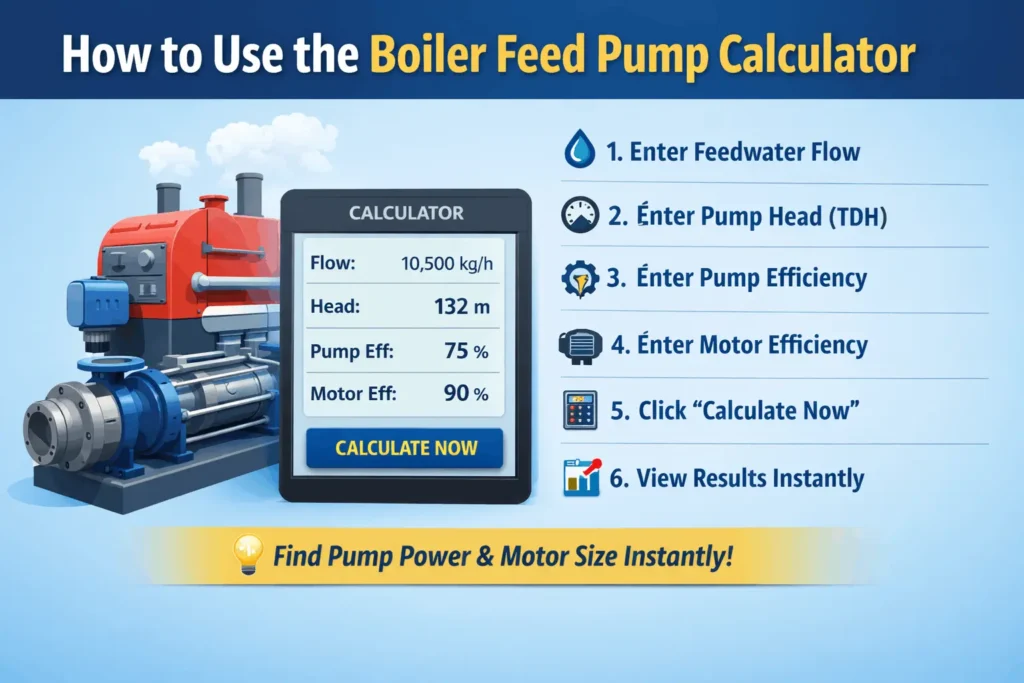
How to Use the Boiler Feed Pump Calculator
Using this tool is simple. Just follow these steps:
Enter Feedwater Flow
Input the flow rate of water going into the boiler
Select the correct unit:
m³/h
L/min
kg/s
👉 Tip: Use your calculated feedwater flow (steam demand + losses)
Enter Pump Head (TDH)
Enter the Total Dynamic Head
Choose unit:
meters (m)
bar
psi
👉 Tip: TDH = static head + pressure + friction losses
Enter Pump Efficiency
Input pump efficiency (%)
Typical range: 65% – 85%
Enter Motor Efficiency
Input motor efficiency (%)
Typical range: 85% – 95%
Click “Calculate Now”
Press the Calculate Now button
The tool will instantly compute results
View Results
You will get:
✅ Hydraulic Power (kW)
✅ Shaft Power (kW)
✅ Motor Power Required (kW)
✅ Converted Flow
✅ Converted Head
✅ Specific Energy
Reset if Needed
Click Clear All Fields to start again
Important Notes
Always enter positive values only
Efficiency must be less than 100%
Use correct units for accurate results
Pro Tip
Before using this tool, make sure you have:
✔ Calculated feedwater flow
✔ Calculated total dynamic head (TDH)
👉 Then use this calculator to find pump power and motor size instantly
Feed Water Pump Sizing Calculation
Correct sizing is critical in engineering.
👉 feed water pump sizing calculation includes:
flow rate analysis
pressure requirement
system losses
Incorrect sizing leads to inefficiency or damage.
Industrial Boiler Feed Pump Calculation
In industrial systems, the calculation becomes more complex.
👉 industrial boiler feed pump calculation considers:
continuous operation
high pressure systems
energy efficiency
This ensures long-term stability.
Boiler Pump Efficiency Calculation Formula
No pump works at 100% efficiency.
👉 boiler pump efficiency calculation formula helps determine energy loss.
Efficiency = Output Power / Input Power
This is important for reducing energy consumption of pump systems.
How to Size a Boiler Feed Pump
Determine Steam Demand
Start with how much steam your boiler needs.
From boiler rating (e.g., kg/h or tons/hour)
Or process requirement
👉 Example:
Boiler produces 10,000 kg/h steam
Calculate Feedwater Flow Rate
Feedwater ≈ steam demand (plus losses)
[
\text{Flow} \approx \text{Steam Demand} \times 1.05
]
👉 Add 5–10% margin for:
Blowdown
Leakage
System losses
✔ Example:
10,000 kg/h × 1.05 = 10,500 kg/h
Calculate Total Dynamic Head (TDH)
This is the most important step.
TDH includes:
Static head (height difference)
Boiler pressure (converted to meters)
Friction losses (pipes, valves)
Safety margin
Formula:
[
\text{TDH} = \text{Static Head} + \text{Pressure Head} + \text{Losses}
]
Convert Boiler Pressure to Head:
[
1 \text{ bar} \approx 10.2 \text{ meters}
]
👉 Example:
Boiler pressure = 10 bar → 102 m
Static head = 20 m
Losses = 10 m
✔ TDH = 132 m
Calculate Required Power
Hydraulic Power:
P = \frac{\rho g Q H}{1000}
Where:
ρ = 1000 kg/m³
g = 9.81 m/s²
Q = flow (m³/s)
H = head (m)
Then include efficiencies:
Shaft Power:
[
\text{Shaft Power} = \frac{\text{Hydraulic Power}}{\text{Pump Efficiency}}
]
Motor Power:
[
\text{Motor Power} = \frac{\text{Shaft Power}}{\text{Motor Efficiency}}
]
Select Pump Type
Based on results:
Common choices:
Multistage centrifugal pump → most common
High-pressure pumps → for large boilers
Vertical pumps → space-saving
Check NPSH (Very Important)
To avoid cavitation:
Ensure:
[
NPSH_{available} > NPSH_{required}
]
👉 Consider:
Tank level
Temperature
Suction piping losses
Add Safety Margin
Always oversize slightly:
Flow: +10%
Head: +5–10%
Motor power: choose next standard size
Quick Example (Real Case)
| Parameter | Value |
|---|---|
| Steam demand | 10,000 kg/h |
| Feedwater flow | 10,500 kg/h |
| Head | 132 m |
| Pump efficiency | 75% |
| Motor efficiency | 90% |
👉 Result:
Hydraulic Power ≈ 37 kW
Motor Power ≈ 55 kW (select 60 kW motor)
Final Checklist
Before selecting pump:
✔ Correct flow rate
✔ Accurate TDH
✔ Efficiency considered
✔ NPSH safe
✔ Safety margin added
✔ Pump curve matches duty point
Pro Tip
Use your calculator tool (the one you built 👏):
👉 Just input:
Flow
Head
Efficiency
And it will instantly give:
Power
Motor size
Performance values
This is a full boiler feed pump sizing calculation method used in real engineering.
Boiler Feed Pump Design Calculation
Proper design ensures long-term reliability.
👉 boiler feed pump design calculation focuses on:
durability
pressure handling
energy efficiency
Boiler Feed Pump Requirements Calculation
Before selecting a pump, requirements must be clear.
👉 boiler feed pump requirements calculation includes:
system pressure
flow demand
safety margin
Centrifugal Pump Calculation
Most boiler systems use centrifugal pumps.
👉 centrifugal pump calculation involves:
impeller speed
flow characteristics
pressure output
Energy Consumption of Pump
Energy usage is a major factor in industrial systems.
Poor calculations lead to high energy cost.
Proper boiler feed pump helps reduce unnecessary consumption and improves efficiency.
Pump System Design Considerations
A good system design ensures:
stable operation
low maintenance
high efficiency
This is part of modern industrial pump sizing practices.
Common Mistakes in Pump Calculation
Many engineers make mistakes such as:
ignoring friction losses
wrong flow assumptions
incorrect efficiency values
These mistakes affect the entire system performance.
Practical Example
If steam demand increases, the pump must supply more water.
By applying boiler feed pump calculation, engineers can adjust:
flow rate
pressure
power
This ensures smooth operation under all conditions.
Related Tools
Pressure Washing Estimate Calculator
Estimate pressure and flow requirements for cleaning systems and equipment.
👉 Link text: pressure washing calculator online
Unit Converter
Convert pressure, flow rate, and other units for accurate pump calculations.
👉 Link text: unit converter online
ROI Calculator
Analyze cost efficiency and return on investment for pump systems.
👉 Link text: roi calculator tool
Bitumen Calculator
Calculate material flow and density, useful for understanding fluid handling concepts.
👉 Link text: bitumen calculator online
Percentage Calculator
Calculate efficiency, losses, and performance percentages in pump systems.
👉 Link text: percentage calculator online
Conclusion
In industrial engineering, accurate boiler feed pump calculate is essential for efficiency, safety, and performance.
From flow rate to pressure and power, every parameter plays a critical role in system design.
Without proper calculation, even the best equipment can fail to perform effectively.
That’s why engineers always rely on structured formulas and methods to ensure optimal results. Learn about this tool in wikipedia.
❓ FAQ
What is boiler feed pump calculation?
Boiler feed pump calculation is the process of determining the correct flow rate, head, and power required for a boiler feed pump to ensure efficient steam system operation.
How do you calculate boiler feed pump capacity?
You calculate boiler feed pump capacity by analyzing steam demand, then determining the required water flow rate, pressure (head), and applying efficiency-based formulas.
What is the boiler feed pump calculation formula?
The basic formula is:
Power = (Flow Rate × Head × Density × Gravity) / Efficiency
This helps in accurate pump sizing and energy estimation.
How to calculate boiler feed pump head?
Boiler feed pump head is calculated by adding static height, pipe friction losses, and boiler pressure requirement to ensure proper water delivery.
How do you size a boiler feed pump?
To size a boiler feed pump, you need to calculate steam demand, flow rate, total head, and pump power requirements based on system conditions.
What is the efficiency of a boiler feed pump?
Boiler feed pump efficiency shows how effectively electrical energy is converted into hydraulic energy. It is calculated using output power divided by input power.
Why is boiler feed pump calculation important?
It ensures proper water supply, stable boiler pressure, energy efficiency, and prevents equipment damage or system failure.
What factors affect boiler feed pump calculation?
Key factors include flow rate, pump head, system pressure, pipe losses, and overall pump efficiency in industrial boiler systems.